
AYURVEDA · MINDFUL LIVING
A reflection on food, consciousness and the extraordinary journey of everything we consume.
Many moons ago, one of my teachers, Dr Vasant Lad, shared a story with our class about a horse and an apple tree. It was a seemingly simple recollection, yet it completely shifted my perspective of how and what we eat, opening my eyes to a world of interconnectivity that extends far beyond what we put on our plates…
The Horse, the Apple Tree and the Cycle of Life
When Dr Lad was growing up in India his family had a small horse who lived at the bottom of their garden. The horse grew up alongside the children, becoming part of the family and everyday the horse would gallop over to the children eagerly as they fed him fallen apples from the garden.
Years passed, the children grew older, as did the horses, until eventually the day came when the little horse passed away. The family decided to honour him by burying the horse in the garden under a small throne.
Lo and behold, after a fews months an apple tree emerged from the shrine 🌳
As so we have this poignant example of the cycle of life:
From Seed → Apple Tree → Horse → Seed → Apple Tree
What appears to be an ending is in fact a new beginning in this endless exchange of energy between the earth and all the life it supports.
Divya Alter talks about how “Our ancestors are present in the soil used to harvest our crops”. The existence of previous generations is woven into the soil, the tress, the living breathing landscape that continues to sustain us.
I often retell Dr Lads story before meals on our retreats because it invites us to reconsider something we do so habitually, often without a second thought. Every ingredient on our plate belongs to a much greater story, one of which the food we consume becomes part of us, just as we are part of natures continual unfolding.
And suddenly, even the most ordinary meal begins to take on an entirely different meaning.
Food is so much more than fuel
In the West, we tend to have a food is fuel mentality, reducing what we eat to a collection of numbers, measuring food by what is contains rather than considering the experience of eating itself.
While nutritional science has an important place in understanding our health, somewhere amongst all the counting and measuring, I wonder whether we’ve lost touch with the more expansive meaning of `nourishment´
In Vedic philosophy, food is understood as an expression of the same life force that animates the natural world. The sunshine, the rain, the richness of the soil and the rhythms of the seasons are all present in what we eat, and through the simple act of eating, that living world becomes part of us.
There is a Sanskrit expression – Annamaya, meaning “made of food” which speaks to the understanding that our physical existence is formed and sustained by what we consume.
“Food is awareness. Food is God. Food is consciousness. Food is the creator”
Dr Vasant Lad.
From this perspective, eating becomes an act of participation in life itself, a moment in which we can recognise and honour the extraordinary relationship between the earth and our own existence.
Introducing Annapurna
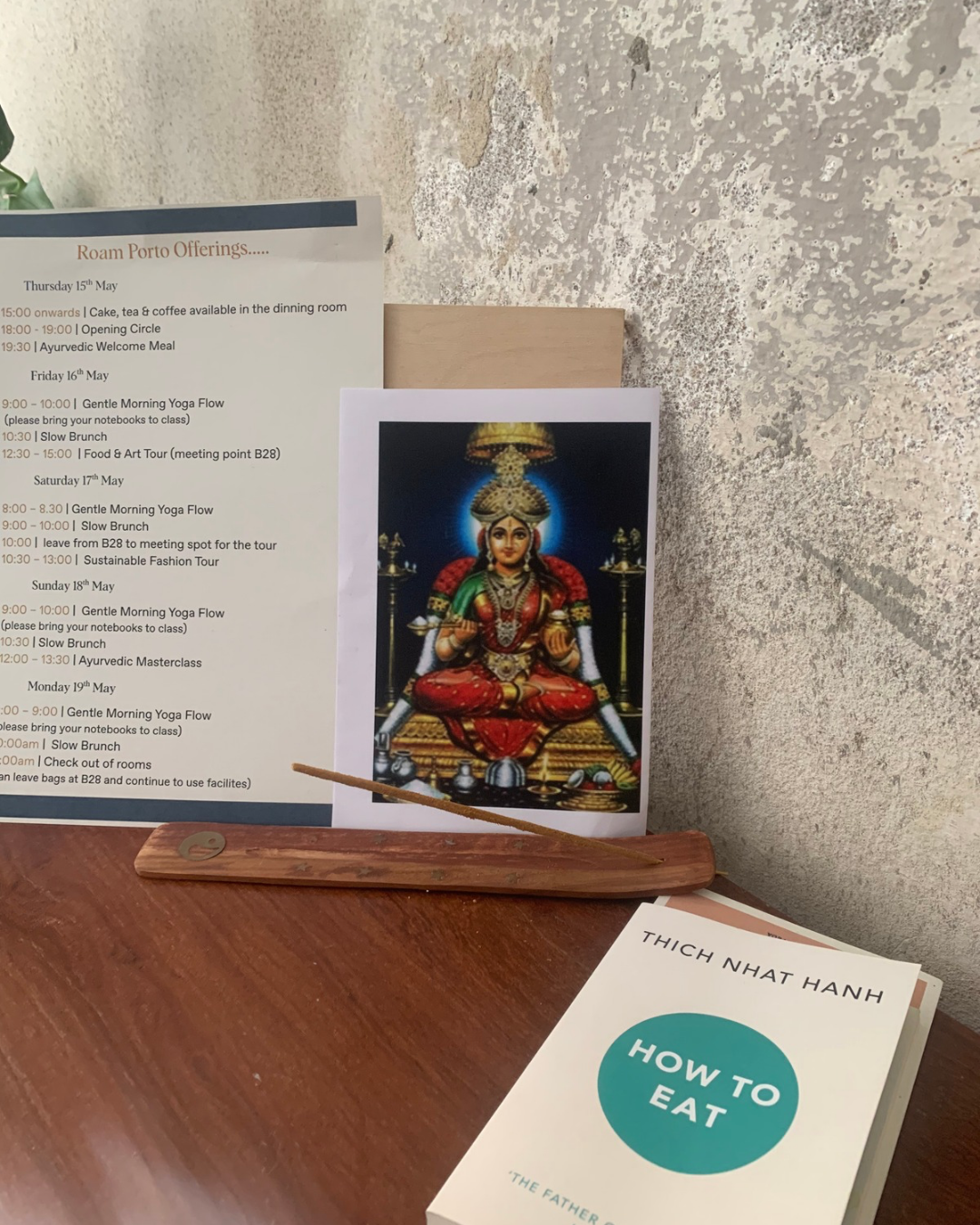
Those of you who have joined me on a Roam Retreat may recognise this image (sometimes I bring the brass goddess) who quietly presides over our meals.
Her name is Annapurna, the Hindu Goddess of food and nourishment, and wherever we find ourselves in the world she takes her place overlooking our dining tables, watching over the food we prepare, the conversations we share and the connections that unfold around her.
Her name comes from the Sanskrit words Anna, meaning food, and Purna, meaning full or complete. Yet Sanskrit is a language of extraordinary depth and Annapurna’s meaning reaches beyond the physical action of being full of food. She represents abundance in its richest sense, the fullness of life, love, gratitude and connection.
Her presence is a gentle reminder that nourishment takes many forms, and that every shared meal offers us an opportunity to experience something beyond the food itself.
Five ways to bring more awareness into the way you eat
The wisdom of Ayurveda can be experienced in the smallest of everyday moments, through the ingredients we choose, the food we prepare and the awareness we bring to our meals.
1. Eat in rhythm with nature
There is a natural rhythm to everything, our bodies, the days, the seasons and the natural world around us. Nature moves in cycles and we too are part of that same ecosystem.
Just as we change our clothes with the seasons, Ayurveda encourages us to change what food we prepare at any given season, allowing the changing landscape to influence what we prepare and eat.
And if you’re unsure where or how to eat in sync with nature, Mother Earth has a rather ingenious way of showing us. Focus on eating what is being harvested around you at this time. Let the local farmers market be your guide.
2. Choose food rich in Prana – natures life force
In Ayurveda, Prana refers to the vital life force that permeates the natural world. In order to harness this prana we want to be eating food as close as possible to its living origins.
Think of a tomato freshly picked from the vine, or vegetables gathered from the garden and prepared the same day. Traditional, Ayurveda considers these foods rich in Prana, whereas food that has spent weeks in storage, been heavily processed or preserved through freezing is thought to have less of this vital energy.
The invitation, then, is to shorten the journey between earth and plate wherever possible. Choose fresh, seasonal produce, shop local, buy smaller quantities more frequently and prepare meals from ingredients that have spent as little time in storage as possible.
3. Explore all the six tastes
Ayurveda recognises six tastes, known as Rasa: sweet, sour, salty, pungent, bitter and astringent.
Each has its own qualities, and together they create a more complete and satisfying experience of eating. By including each and every taste in your food we avoid experiencing cravings after meals.
In Western diets, we often gravitate towards the familiar sweet and salty flavours, while the more subtle bitter, pungent and astringent tastes are sometimes avoided.
Have you ever wondered why a traditional Indian meal might arrive with several different dishes accompanied by chutneys and pickles? these accompaniments are often chosen to compliment one another, bringing the six tastes together into one single meal.
Perhaps next time you’re preparing food, notice which tastes are present and which are missing. A squeeze of lime, and handful of bitter greens or a little warming ginger can bring another dimension to even the simplest dish.
4. Make cooking an act of self-care
In Ayurveda, cooking is traditional regarded as a sacred act, an opportunity to bring awareness, creativity and intention into something that can otherwise be seen as another chore.
There is something deeply human about preparing food for another person, knowing that the time, attention and care we put into a meal will become party of their experience.
And the same generosity can be extended to ourselves.
Perhaps choose one meal this week to prepare without rushing, allowing yourself to enjoy the colors, fragrances and textures of the ingredients, the warmth rising from the pan, the rhythm of your hands and they move through the familiar motions of preparing food.
5. Practise mindful eating
We spend so much time thanking about what we eat that we often forget to consider how we eat. Between answering emails, scrolling through our phones and rushing from one thing to the next, its easy to consume and entire meal without every really experiencing it.
“This food is a gift of the earth, the sky, numerous living beings and much hard and loving work”
Thich Nhat Hanh
Before your next meal take three slow, conscious breaths and allow yourself to fully arrive in the moment. Notice the colours, textured and aromas of the food infant of you, then choose an ingredient on the plate and trace its journey back to its origins. The soil that cradled it, the sunshine and rain that nourished it, the hands that planted, harvested and transported it, perhaps even someone who lovingly prepared it for you.
Consider how many seemingly insignificant moments had to come together to make this meal possible, and silently offer a little gratitude to everyone and everything that played a part.
This meal is a miracle.
You are a miracle.
And we are all part of this extraordinary interconnectedness of life.
A taste of Roam
Food has always been at the heart of our Retreats, where gathering around the table becomes an opportunity to experience these philosophies first hand.
If you feel drawn to experience a little of this for yourself, explore our upcoming retreats and experiences on our When & Where page.
Feel inspired to explore further?
If this has stirred your curiosity, my online Healing Secrets of Ayurvedic Cooking workshop explores how to bring these ancient teachings into your own kitchen.
With love and appreciation, Hayley