
BEAUTY · ALL SEASONS · VATA BALANCING
This Ayurvedic skin tonic draws on ingredients traditionally used to support the skin and balance the increasing dryness of Vata. A simple daily ritual designed to support ojas — the vital essence Ayurveda associates with strength, resilience and radiance.
About this recipe
I first learnt about Ayurvedic beauty rituals during my studies many years ago. I was in my early 30s at the time and, if I’m honest, skincare and graceful ageing didn’t feel particularly relevant to me.
Pregnancy was the catalyst for changing the way I thought about skincare. Products I’d been applying routinely for years suddenly came with advice to stop using them or avoid particular ingredients while pregnant. It made me look much more closely at what was actually in all those lotions and potions I was applying to my skin every day.
A year on, I’m now in my mid-40s, postpartum and with a one-year-old who seems to have other ideas about my eight hours of beauty sleep. Skincare and graceful ageing have naturally become more interesting to me, and I’ve found myself dusting off my old Ayurvedic textbooks and returning to those beauty rituals with a completely different perspective.
This drink is one of the practices I’ve brought back. It’s been my go-to for the past few months. The rose petal powder smells incredible, I love the ritual of making it, and it has quickly become something I genuinely look forward to each day. Alongside the other changes I’ve made to my skincare and daily routines, I’ve noticed a real difference in the condition and complexion of my skin.
Vata, Skin & Graceful Ageing
Within Ayurveda, the different stages of life are associated with the three doshas: Vata, Pitta and Kapha.
Childhood is considered more Kapha-dominant, adulthood more Pitta-dominant and later life increasingly Vata-dominant.
Vata is governed by the elements of air and ether and carries qualities that include dry, light, cold and mobile. As Vata naturally becomes more prominent with age, we can see some of those same qualities reflected in the body: increased dryness, loss of softness and changes in the tone and texture of the skin.
One of Ayurveda’s foundational principles is:
samānya viśeṣa siddhānta
like increases like, and opposites bring balance.
So the intention isn’t to prevent ageing. Ageing is natural. Instead, Ayurveda introduces qualities that help counter unnecessary dryness and depletion.
Where there is dryness, we introduce oil and lubrication. Where there is depletion, we introduce augmenting foods and practices that build, restore and support the tissues.
Which brings us rather neatly to this recipe.
Ayurvedic Skin Tonic with Saffron & Rose
SERVES 1 | PREPARATION 2 minutes | COOKING 5 minutes | BEST FOR All seasons | DOSHA Vata / Tridoshic
Ingredients
- 1 cup organic full-fat cow’s milk
- 1 tsp rose petal powder
- Approximately 5 saffron strands
- ½ tsp turmeric
- Approximately ⅛ tsp ground cardamom
- 1 tsp ghee
A note on the milk: Use good-quality full-fat milk where possible. If milk feels too heavy, use ½ cup milk and ½ cup water. If cow’s milk isn’t well tolerated, homemade almond milk made with soaked and peeled almonds can be used instead.
Preparation & Method
1. Combine the ingredients
Add the milk, rose petal powder, saffron, turmeric and cardamom to a small saucepan.
2. Heat gently
Bring to a low boil, then immediately reduce the heat.
3. Simmer
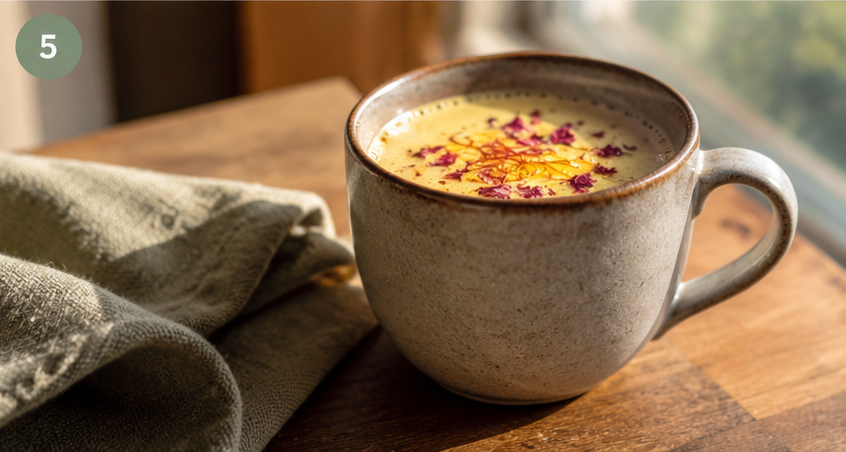
Simmer gently for one to two minutes. The milk will take on the golden colour of the turmeric and saffron, while the rose petal powder gives it its distinctive floral aroma.
4. Add the ghee
Remove the pan from the heat. Add 1 teaspoon of ghee and stir until it has melted into the warm milk.
5. Serve
Pour into your favourite mug and drink warm.
The Ayurvedic Perspective
At the heart of this recipe is the Ayurvedic concept of ojas.
Ojas is described in Ayurveda as the refined essence of healthy tissues. It is associated with vitality, strength, resilience, reproductive health and immunity, and is reflected externally in the lustre of the skin, brightness of the eyes and a healthy complexion.
I like to think of ojas as a savings account. Our everyday choices either make deposits or withdrawals.
Adequate sleep, rest, restorative practices and augmenting foods help build our reserves. Chronic stress, insufficient sleep, overexertion and continually pushing beyond our capacity gradually draw from them.
This gives Ayurvedic beauty a very different starting point. Rather than concentrating solely on what we apply to the surface of the skin, we also look at how well the body and its tissues are being supported from within.
The Sanskrit term bṛṃhaṇa describes foods, therapies and practices that augment or build the body. Milk and ghee are two classic examples, making them particularly relevant when considering Vata, dryness and graceful ageing.
Benefits & Traditional Uses
Full-fat milk — augmenting and restorative
is considered bṛṃhaṇa in Ayurveda: augmenting, strengthening and supportive of the body’s tissues. Its sweet, soft and unctuous qualities help counter the lightness and dryness associated with Vata. Interestingly, human research into milk-derived sphingomyelin — a component associated with milk fat — has also found improvements in measures of skin hydration and elasticity.
Ghee — lubrication and rejuvenation
Ghee brings snigdha, the oily or unctuous quality that helps counter dryness and supports internal lubrication. It is also classically regarded as a rasāyana — part of Ayurveda’s approach to rejuvenation, maintaining vitality and supporting longevity.
Saffron — complexion and lustre
Saffron, or kuṅkuma, is used in Ayurvedic beauty preparations for varṇya — supporting healthy colour, complexion and lustre of the skin.
Rose petal powder — cooling and balancing
Rose brings cooling and soothing qualities, helping to balance excess heat. This makes it particularly useful for Pitta-type skin, where heat may present as redness or sensitivity. It also gives the drink its distinctive floral scent. Modern research is beginning to look at rose from a skin-health perspective too: a recent human clinical trial found improvements in skin hydration, elasticity and brightness following supplementation with rose petal extract.
Turmeric — clarity and complexion
Turmeric is widely used in Ayurvedic beauty practices, both internally and externally, and is valued for supporting clear skin and an even complexion. There is now some modern evidence alongside this traditional use: a randomised, placebo-controlled human study found that oral turmeric extract improved skin hydration, barrier function and facial blemishes over 60 days.
Cardamom — aromatic and balancing
Cardamom brings a lighter, aromatic quality to the richness of the milk and ghee. It is used to support the digestion of heavier foods while giving the drink its fragrant finish.
Together, the ingredients bring the augmenting and oily qualities that become particularly useful as Vata increases — supporting the tissues while helping to counter dryness from within.
Make it Work for Your Dosha
Vata
This recipe is particularly suited to Vata. Use full-fat milk and the full 1 teaspoon of ghee. Its augmenting, soft and oily qualities oppose Vata’s light and dry nature, making it particularly appropriate when the skin feels dry or the body feels depleted.
Pitta
The cooling qualities of milk, ghee and rose help balance Pitta’s heat, making the original recipe particularly suitable when the skin tends towards redness, heat or sensitivity. Keep to the original recipe rather than making it more heating.
Kapha
The richness of full-fat milk and ghee can be too heavy for Kapha. Use ½ cup full-fat milk and ½ cup water, and reduce the ghee to ½ teaspoon.
Have You Made This Recipe?
Try making this every evening for two weeks and see if you notice any difference in the moisture, condition or complexion of your skin.
Then come back and let me know in the comments below. I’d genuinely love to hear how you get on.